

Climate & Energy · South Africa · E-mobility
South Africa’s plug-in boom outruns its chargers: newcomer SAEV Charge builds fast while GridCars replaces its first-generation units
New-energy vehicle sales have already beaten 2025’s total and petrol is above R30 a litre, but fast DC charging has barely grown. Drivers face holiday queues and typical prices of R7 a kWh, while a battery-backed newcomer charges from R2.49/kWh in Cape Town.
CAPE TOWN — South Africans are buying cars that plug in faster than the country is building places to plug them in. Sales of new-energy vehicles reached 22,389 by the end of September, already 34% more than the 16,703 sold in the whole of 2025, according to Naamsa figures analysed by TechCentral. One in nine new cars sold in September was a new-energy vehicle.
Most of the growth is in plug-in hybrids: 8,082 so far this year, against 3,217 fully electric cars and 11,090 conventional hybrids that cannot be charged from the grid. Rechargeable cars now make up just over half of new-energy sales, though battery-electric models are still less than 1% of the roughly 490,000 new vehicles sold. Fuel is doing the persuading. Inland 95-octane petrol passed R30 a litre for the first time in October.
South Africa is still catching up with the rest of the world. About 20 million new-energy vehicles were sold globally in 2025, some 13 million of them in China and about 4.2 million in Europe, and the total is heading towards 23 million, according to WesBank’s 2026 new-energy vehicle report, which FNB’s Linda Musonda discussed on Moneyweb’s SAfm Market Update. Locally, a wave of models under R400,000 is bringing the technology within reach of far more buyers.
The queue problem
Drivers should expect to queue at public chargers this summer holiday, MyBroadband warned. Reported battery-electric sales are up 301% on last year, and brands that do not report to Naamsa, such as Geely, Dongfeng and iCaur, have probably added at least 2,500 more. Plug-in hybrid owners facing R30 petrol are plugging in as often as they can, too.
On paper there is still room. The WesBank report puts South Africa at about one public charger for every seven vehicles, comfortably inside the benchmark of one per ten that is usually considered enough. But that headroom shrinks quickly if demand jumps, and on the busiest holiday routes, where drivers all need the same few fast chargers on the same days, it already feels thin.
Fast DC charging on the main routes, meanwhile, has barely moved. GridCars and Rubicon built out 300 to 400 locations early, which once gave South Africa one of the best charger-to-car ratios in the world. This year’s biggest addition was Zero Carbon Charge’s 12 DC and four AC chargers at two N3 sites. Operators are already rationing: Rubicon has posted idling-fee warnings at busy sites such as Mall of Africa, and Chargify caps sessions at 45 minutes at Benmore Gardens in Sandton. Rubicon’s head of e-mobility, Hilton Musk, says Chinese carmakers bringing in EVs are not investing in charging.
What EV charging costs in South Africa
Public fast charging is not cheap. The going DC rate is about R7.00 per kWh on Rubicon and R7.35 on GridCars and Chargify, and Zero Carbon Charge’s solar-powered, off-grid hubs charge R9.15. At GridCars’ price, a fast-charged EV costs only a little less to run than a comparable petrol car. Charging at home is still far cheaper.
The exception is SAEV Charge’s station at the Solar MD battery factory in Richmond, Cape Town. Drivers there pay R3.49 per kWh, dropping to R2.49 when the site’s solar-fed battery is above 90%, MyBroadband reported, among the lowest published DC rates in South Africa and less than half the national norm.
Fleets do the maths
Businesses may move faster than households. Total cost of ownership is driving the switch, starting with last-mile delivery and spreading into logistics and transport, where firms are seeing savings of about 10% or more. With diesel above R30 a litre, the case for electric trucks is getting stronger, and more operators are expected to follow as chargers appear along the major routes.
GridCars rebuilds its first generation
South Africa’s largest operator is spending its money on replacing old hardware. GridCars is putting R40 million into refreshing more than 40 sites, some with chargers installed in the earliest years of electric mobility in South Africa and in service for more than a decade, the company said. Its first-generation units were built around 500V technology. The new 120 kW dual-connector chargers handle cars from 150V to 1,000V, and slower AC ports are being swapped for a second DC gun, which should ease some congestion.
SAEV Charge: three sites in a month
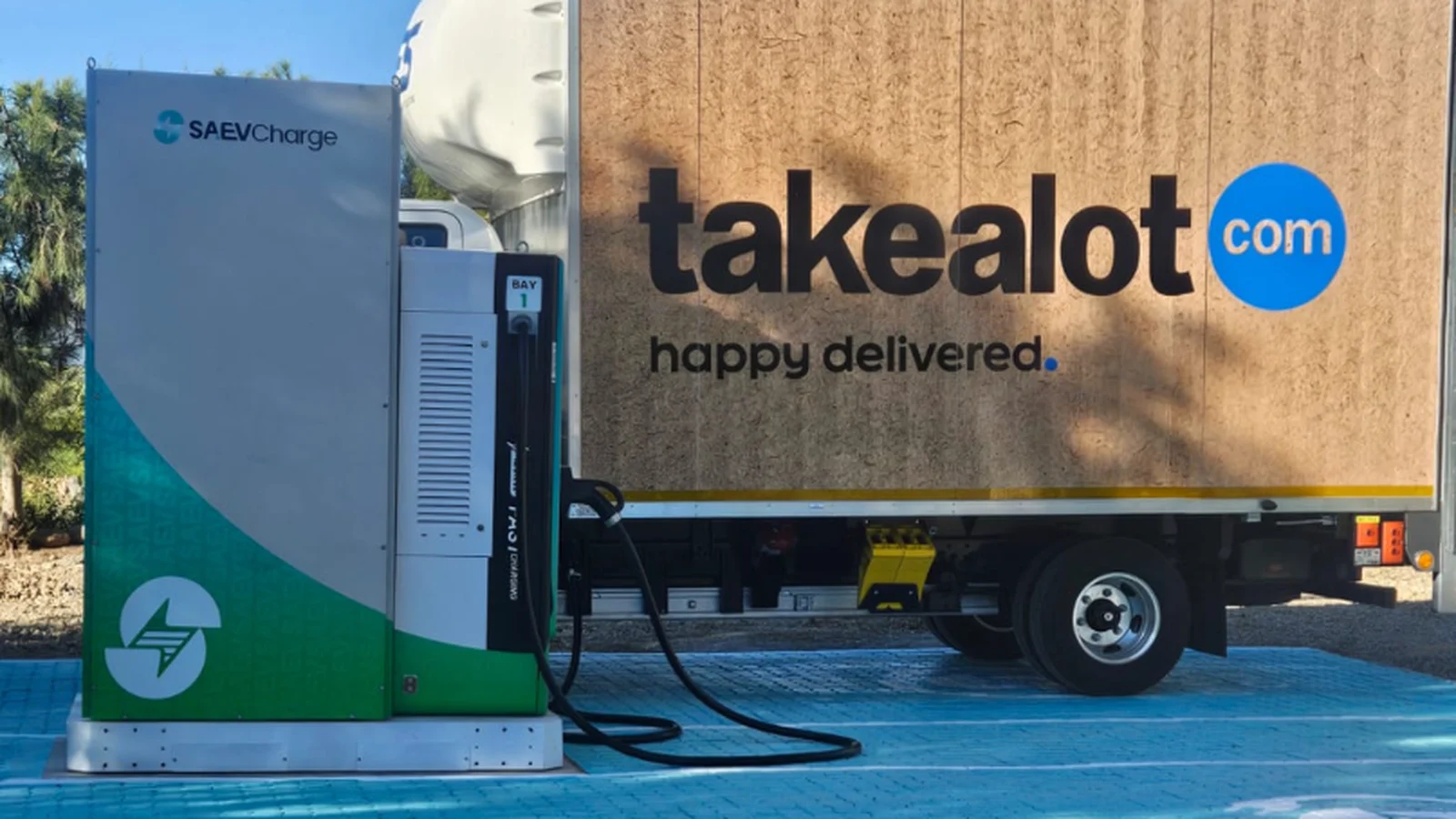
SAEV Charge, the only other major new player, builds a different kind of station. Each unit carries a 272 kWh Solar MD lithium-iron-phosphate battery that refills from a connection of about 10 kW and discharges into the car at 120 kW or more. A host does not need an expensive grid upgrade before it can offer fast charging, and because the station runs from its own battery, both bays keep working through load shedding. That matters on the N1 through the Western Cape, where its De Doorns and Paarl stations keep charging when the grid goes down.
The company moved quickly. When it announced its expansion on 5 October, it had one public DC station, at Richmond, and promised Paarl and De Doorns by mid-October. Both are now live, at RIVO Quarters in Paarl and Die Veldskoen Padstal on the N1, where Takealot delivery trucks already charge. Pretoria, Centurion and Tzaneen are next, then the N7 and the Garden Route, under a Phase 1 plan for 100 battery-backed stations and a target of 400 within four years. Demand from site hosts currently outstrips supply, and SAEV is prioritising the highest-value sites for drivers first.
As industry expert Ben Viljoen noted in AB24’s earlier report on the network, the station’s battery is built by Solar MD in Cape Town, giving the operator and its supplier a shared local base.
AB24’s reading from Cape Town: the plug-in surge is real and the holiday queues are coming. Three battery-backed sites will not fix a national shortage, but a station that needs no large grid connection can be rolled out faster than one that needs a substation upgrade at every stop. Watch how many of SAEV’s Gauteng and Limpopo sites open before December, and when GridCars finishes its refresh.
Questions drivers are asking
How much does it cost to charge an EV in South Africa?
At home, about the price of your electricity tariff, often R3.50 to R5 a kWh. At public DC fast chargers the going rate is about R7.00/kWh on Rubicon and R7.35/kWh on GridCars and Chargify, and R9.15/kWh at Zero Carbon Charge’s off-grid hubs. AC public chargers are usually R5.88/kWh.
Where is the cheapest DC fast charging in South Africa?
One of the lowest published DC rates is at SAEV Charge’s station at the Solar MD factory in Richmond, Cape Town: R3.49/kWh, dropping to R2.49/kWh when the site’s solar-fed battery is above 90%.
How much does SAEV Charge cost per kWh?
At Richmond, R3.49/kWh, or R2.49/kWh when the site battery is above 90% charge. SAEV has not yet published prices for its De Doorns and Paarl stations.
Will there be queues at EV charging stations this holiday?
Probably, on the busiest routes. EV and plug-in hybrid sales have surged while fast DC charging on the highways has barely grown, so drivers should plan stops, charge fully at home before leaving and consider overnight stays where they can charge.
Do EV chargers work during load shedding?
Most grid-connected chargers stop when the power goes. SAEV Charge’s stations run from their own 272 kWh battery, so both bays keep working through load shedding and outages.
How many public EV charging stations does South Africa have?
GridCars and Rubicon, the two biggest networks, cover roughly 300 to 400 locations between them, with newer operators such as Zero Carbon Charge and SAEV Charge adding sites.
Is South Africa ready for electric vehicles?
Getting there. Sales are rising fast, more models now cost under R400,000, and WesBank’s 2026 report puts the country at about one public charger for every seven vehicles, still inside a comfortable benchmark of one per ten. A sharp jump in demand would strain that, and holiday routes already feel it.
Do electric trucks save money in South Africa?
For many fleets, yes. Total cost of ownership is driving the switch, starting with last-mile delivery, and logistics firms are seeing savings of about 10% or more, with diesel above R30 a litre. More operators are expected to switch as chargers appear along major routes.
Sources: TechCentral; MyBroadband; MyBroadband; GridCars; Engineering News; Rubicon; Zero Carbon Charge; SAEV Charge; Moneyweb.
— AB24 · Cape Town