

Business · South Africa · Automotive
A month of petrol can now cost as much as an instalment on South Africa's cheapest electric cars
Inland 95 petrol is still R30.24 a litre after October's record. New battery-electric cars start at R339,900, and some advertised finance deals put the monthly instalment close to a typical fuel bill, though those deals usually leave a large balloon payment at the end.
South Africans filling up at inland pumps are still paying R30.24 a litre for 95 unleaded petrol, a cent below the record set in October. At that price, a typical month's petrol can cost as much as the advertised monthly instalment on the country's cheapest new electric cars. The comparison holds only on certain finance deals, and those deals usually leave a large payment at the end.
The Department of Mineral and Petroleum Resources set the inland 95 price at R30.25 a litre from 7 October, the first time it had gone through R30. It eased by a single cent from 4 November. In February, before the latest rise in international product prices and a weaker rand, the same litre cost R20.10, official price lists show. That is an increase of just over 50%.
Diesel has risen further. The official inland wholesale price of 50ppm diesel reached R32.80 a litre in October, up from R17.96 in February, an increase of about 83%. Unlike petrol, diesel pump prices are not regulated, so drivers often pay more than the wholesale list. Temporary levy relief, announced in the October medium-term budget statement, cut R1.50 a litre off petrol and R3.00 a litre off diesel from 4 November, which is why the official inland wholesale diesel price is now R31.60. That relief is due to shrink from 2 December.
Market estimates based on the Central Energy Fund's daily over-recovery figures have pointed to a petrol cut of about R3 a litre next month, once a scheduled 50-cent reduction in the levy relief is included. The outlook for diesel is much thinner, because more of the diesel levy cut is due to lapse. The department has not yet announced December's prices, which are due to take effect on 2 December.
The cheapest new battery-electric car on sale in South Africa is now the Geely E2 Aspire, listed from R339,900 on the manufacturer's website. BYD's Dolphin Surf Comfort is listed at R341,900. Both sit well below the R360,000 mark that FNB and WesBank senior economist Thanda Sithole has cited as a turning point for ordinary buyers.
Geely's official South Africa website is advertising a 48-month finance deal on the E2 from R4,199 a month, with a 10% deposit and a 59% guaranteed future value. That residual, about R200,500, is still owing at the end of the term unless the buyer refinances, pays it or hands the car back under the deal's terms. It is not the same as paying the car off.
A driver covering 20,000 km a year, the distance the Automobile Association has used in its cost-of-ownership examples, in a petrol car that uses 8 litres per 100 km would spend R4,032 a month at the current inland 95 price. That is almost the same as the advertised Geely instalment.
Paying the Geely off in full costs more. On a 10% deposit, with the remaining R305,910 financed at the prime lending rate of 10.75% over 72 months and no balloon, the monthly instalment would be about R5,780. The Reserve Bank left the repo rate unchanged at 7.25% on 19 November, keeping prime at 10.75%.
Source: AB24 calculations from official Department of Mineral and Petroleum Resources prices, Geely's advertised finance terms and the prime lending rate of 10.75%. Home charging uses an illustrative mid-range tariff of R4.00 a kWh; public charging uses about R7.00 a kWh. Both electricity rates vary by municipality and network.
Electricity is cheaper than petrol, even at today's tariffs. A compact electric car using about 13 kWh per 100 km over the same 20,000 km a year would use about 217 kWh a month. At a mid-range home tariff of about R4.00 a kWh, that is about R870. Public direct-current chargers commonly charge around R7.00 a kWh, which would lift the same distance to about R1,520. Home rates vary by municipality and time of use, and public tariffs vary by network.
Sithole, speaking on Kaya Biz and reported by Daily Investor, said buyers could now put what they spend on fuel each month towards an instalment on a new-energy vehicle, but should still weigh the total cost of ownership, including whether they can charge the car. He also said government subsidies to speed up adoption may be hard to fund.
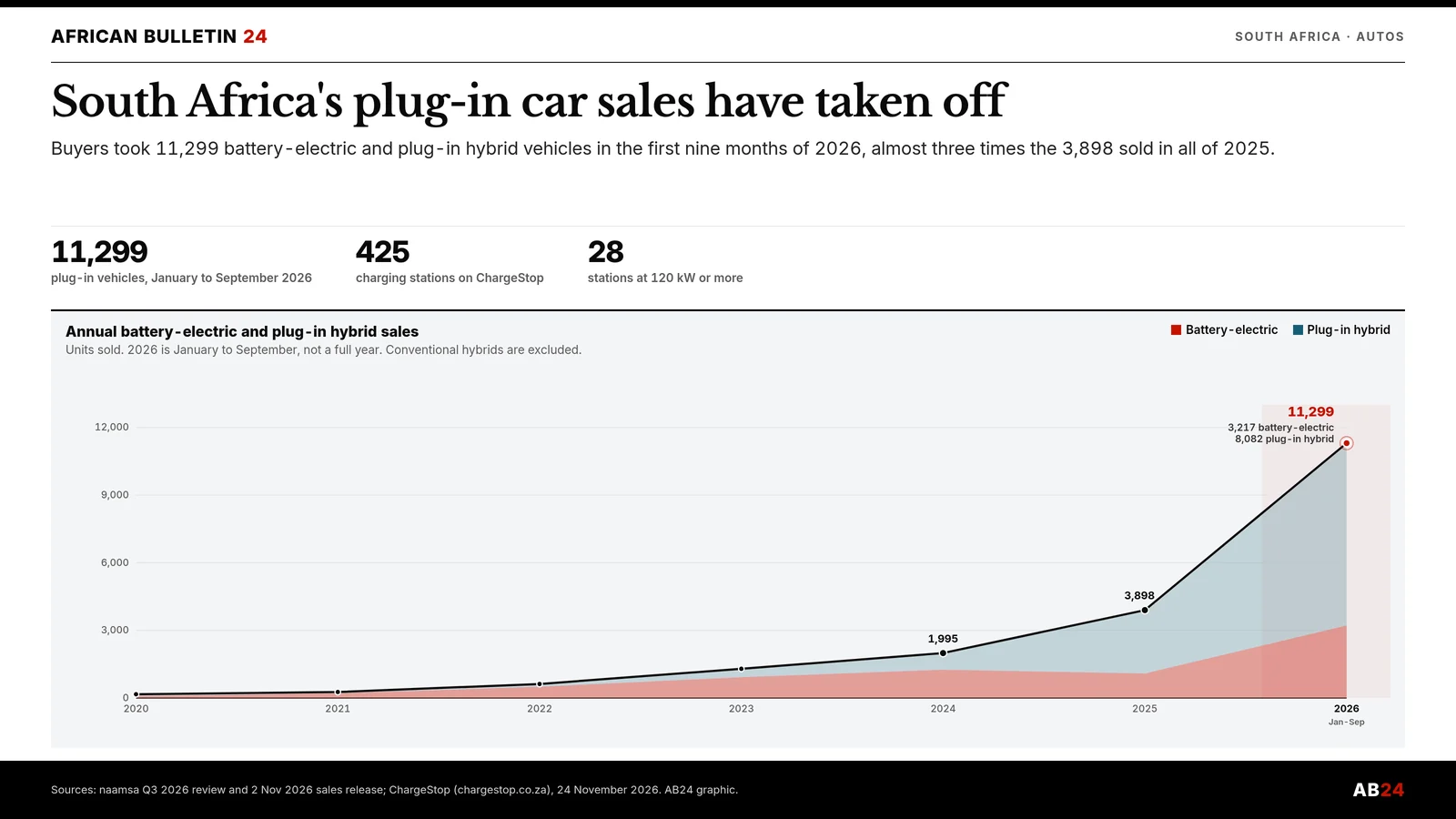
New-vehicle sales have kept rising despite the fuel shock. The Automotive Business Council, naamsa, said 61,890 new vehicles were sold in October, 10.4% more than a year earlier. Sales for the first ten months reached 554,081, up 12.3%, according to the National Automobile Dealers' Association. Combined sales of hybrids, plug-in hybrids and battery-electric vehicles reached 22,389 in the first nine months, already 34% above the 16,703 sold in the whole of 2025. Fully electric cars are still a small part of that mix: 3,217 battery-electric vehicles were sold in those nine months, beside 8,082 plug-in hybrids and 11,090 conventional hybrids.
The chart below shows how sharply plug-in sales have risen, and how the public charging network is still concentrated in a few provinces.
South Africa’s plug-in car sales have taken off
Buyers took 11,299 battery-electric and plug-in hybrid vehicles in the first nine months of 2026, almost three times the 3,898 sold in all of 2025. Conventional hybrids, which do not plug in, added another 11,090, taking all new energy vehicles to 22,389.
Third quarter, battery-electric only: sales rose 466% year on year, from 232 to 1,314, off a low base. naamsa said 2026 totals were also supported by new brands starting to report sales.
The public charging record
By highest power: 28 at 120 kW+, 108 at 50-119 kW, 271 at 22-49 kW, 18 under 22 kW.
Fastest public chargers
Charging free at home
Many drivers are motivated by charging free at home, which is an excellent addition if you already have rooftop solar. Midday solar is strongest from 10:00 to 15:00, and a rooftop system follows the same sun.
Sources: naamsa Q3 2026 review (12 Nov) and 2 Nov 2026 sales release; ChargeStop (chargestop.co.za), 24 November 2026; GridPulse ZA / Eskom hourly solar PV averages (from April 2022). Solar bars are grid-scale, not rooftop.AB24
Statistics South Africa has already shown the fuel surge in the inflation numbers. Headline inflation rose to 5.2% in October, and the Reserve Bank's split decision to hold rates later in November underlined how tightly fuel is now bound up with the cost of borrowing.
The instalment-versus-fuel comparison works best for motorists who can charge at home, who accept a balloon payment or a longer loan, and who drive far enough for petrol to hurt. It is not a complete account of what a car costs. Insurance, the residual value at the end of a finance deal, and access to chargers on longer trips still decide whether the cheaper electricity bill is enough.
SourcesShow
- Department of Mineral and Petroleum Resources, "Breakdown of petrol, diesel and paraffin prices as at 04 February 2026". https://www.dmpr.gov.za/Portals/0/Resources/Fuel%20Prices%20Adjustments/Fuel%20Prices%20Per%20Zone/2026/January%202026/Breakdown-of-Prices.pdf
- Central Energy Fund, on behalf of the Department of Mineral and Petroleum Resources, "Media statement: Price changes to be effected on Wednesday 07 October 2026", 2 October 2026. https://cefgroup.co.za/wp-content/uploads/2026/10/Press-Release-02-October-2026-Change-07-October-2026.pdf
- Department of Mineral and Petroleum Resources, "Minister of Mineral and Petroleum Resources announces fuel price adjustments | Effective 04 November 2026", 2 November 2026. http://www.dmpr.gov.za/Media-Centre/ArtMID/1168/ArticleID/1056/MEDIA-STATEMENT-MINISTER-OF-MINERAL-AND-PETROLEUM-RESOURCES-ANNOUNCES-FUEL-PRICE-ADJUSTMENTS-%7c-EFFECTIVE-04-NOVEMBER-2026
- Central Energy Fund, on behalf of the Department of Mineral and Petroleum Resources, "Media statement: Price changes to be effected on Wednesday 04 November 2026", 30 October 2026. https://cefgroup.co.za/wp-content/uploads/2026/11/Press-Release-30-October-2026-Change-04-November-2026.pdf
- Geely South Africa, "Geely E2" model page, accessed 24 November 2026. https://www.geelyauto.co.za/models/geely-e2
- Rola BYD, "BYD Dolphin Surf Price & Specs", accessed 24 November 2026. https://www.rolabyd.co.za/vehicle/byd-dolphin-surf/
- naamsa, "October 2026 New Vehicle Sales Media Release", 2 November 2026. https://naamsa.net/wp-content/uploads/2026/11/20261102-naamsa-October-2026-New-Vehicle-Sales-Media-Release.pdf
- National Automobile Dealers' Association, "October Vehicle Sales Reach Highest Level Of The Year", 3 November 2026. https://nada.co.za/october-vehicle-sales-reach-highest-level-of-the-year/
- Daily Investor, "South Africans can now spend more on fuel each month than it costs to pay off an electric vehicle", 22 November 2026, reporting remarks by Thanda Sithole on Kaya Biz. https://dailyinvestor.com/energy/165359/south-africans-can-now-spend-more-on-fuel-each-month-than-it-costs-to-pay-off-an-electric-vehicle/
- South African Reserve Bank, "Statement of the Monetary Policy Committee", 19 November 2026. https://www.resbank.co.za/en/home/publications/publication-detail-pages/statements/monetary-policy-statements/2026/november/
- Automobile Association of South Africa, "Do you know the cost of your vehicle?", 7 December 2020. https://aa.co.za/do-you-know-the-cost-of-your-vehicle-2/
- Rubicon, "EV charging tariffs in South Africa: What you'll pay to power your electric vehicle". https://www.rubicon.tech/blogs/e-mobility/ev-charging-tariffs-in-south-africa-what-you-ll-pay-to-power-your-electric-vehicle
- naamsa, "Q3 2026 Quarterly Review of Business Conditions", 12 November 2026. https://naamsa.net/wp-content/uploads/2026/11/20261112-Q3-2026-naamsa-Quarterly-Review-of-Business-Conditions.pdf
- ChargeStop, charging station record, accessed 24 November 2026. https://chargestop.co.za/
- GridPulse ZA, "Time of day" averages of Eskom hourly grid-scale solar photovoltaic output from April 2022, accessed 24 November 2026. https://gridpulse.org.za/data/time-of-day
- African Bulletin 24, "South Africa's inflation jumps to 5.2% in October as fuel prices surge", 18 November 2026. https://africanbulletin24.com/stories/south-africa-cpi-inflation-october-2026-5-2-percent-fuel
AB24 · Johannesburg