

Politics · South Africa · Fact check
Who will be Johannesburg’s mayor? Fact check: the DA needs 136 council seats, not 51% of the vote
A widely shared post says the DA needs another 17.1% of the vote to make Helen Zille mayor. The real test is seats: the DA has 91 of 270 and needs 45 more to reach a majority.
The short version
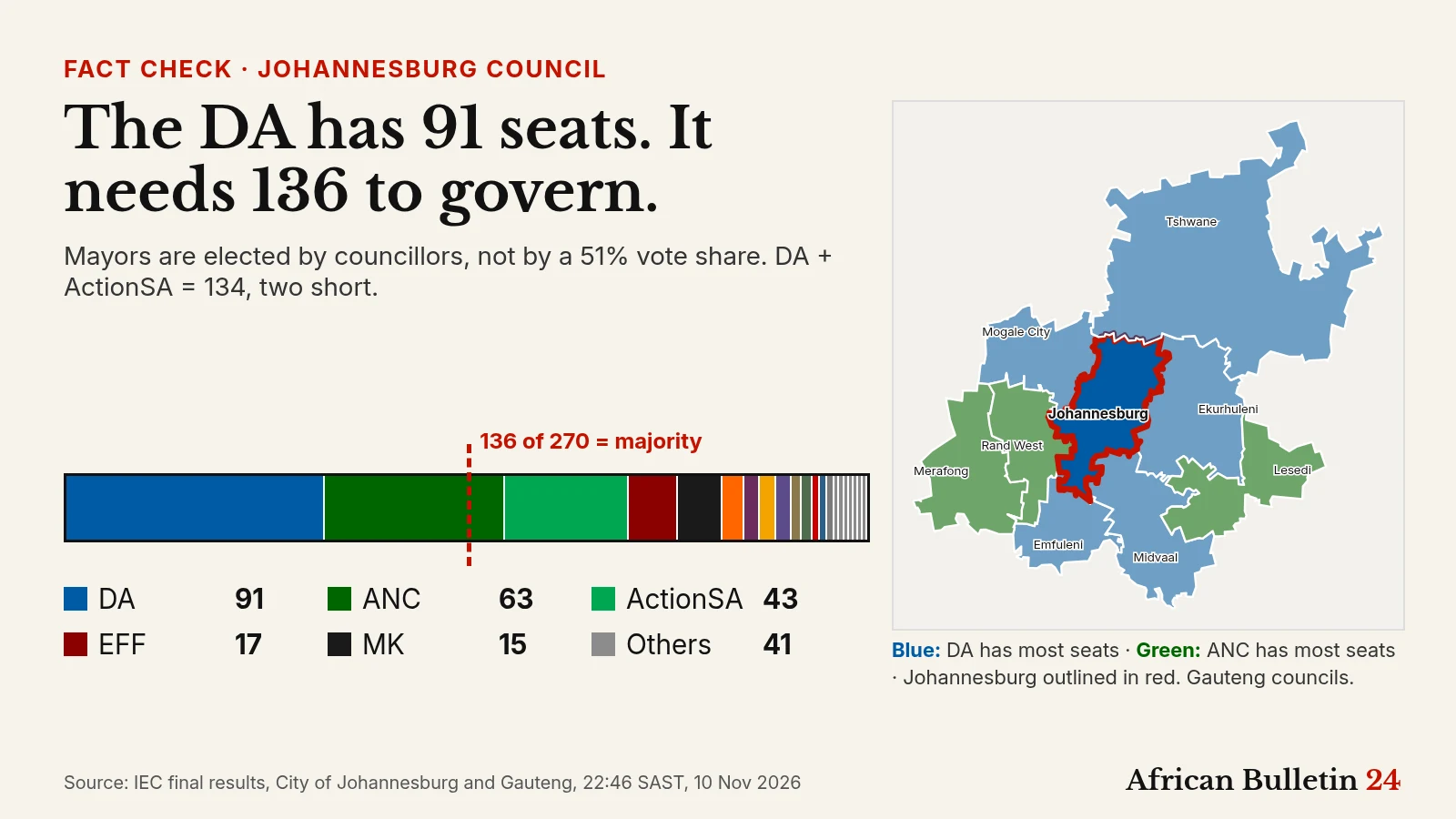
A widely shared post said the DA needed 51% of the vote for Helen Zille to become mayor of Johannesburg. No party won the city outright, so the DA will need partners. Mayors are elected by councillors, so the number that matters is 136 of the council’s 270 seats, not a share of the vote. The DA has 91 seats, and with ActionSA it reaches 134, two short of a majority.
JOHANNESBURG. A post shared widely this week says: “In order for Zille to become Johannesburg Mayor, the DA needed 51% majority as the DA usually achieves in Cape Town. In Gauteng DA got 33.9%, so they need to form a coalition with other parties that will bring 17.1% or more to get majority.”
The main point holds up. The DA needs help to run the city. The numbers do not.
How a mayor gets chosen
- Voters mark two ballots. One ballot picks a ward councillor. The other picks a party.
- Votes become seats. Johannesburg’s council has 270 seats. 135 go to ward winners. The other 135 are topped up from party lists, so each party’s seats roughly match its share of the votes.
- Councillors pick the mayor. At the council’s first meeting, which must be called within 14 days of the council being declared elected, councillors vote in secret. The winner needs a majority of the votes cast, meaning more than half, not simply the most. If nobody gets there, the last-placed candidate drops out and they vote again. What happens next, and if the vote stalls, is explained below.
- 136 is the number that counts. At least 136 councillors must be in the room for the vote. And the city’s budget needs 136 “yes” votes. So any party that wants to govern needs a team of 136.
Johannesburg council: 270 seats, 136 needed to govern
Each bar is measured against the 136-seat line (dashed red). Also with seats: ATM 3, Al Jama-ah 3, SACP 2, ACDP 2, Mayibuye 2, AIC 1, BOSA 1, PMC 1, PAC 1, ELF-SA 1, APC 1, AHC 1.
Explore the map: where every party stands
The map opens on Gauteng. Tap Johannesburg, or any council, to see its seats and who came first. Use the trail at the top to go back up to the province or the whole country.
Jump to: Johannesburg · Gauteng · Tshwane · Ekurhuleni · Cape Town · All of South Africa
2026 local election results map
Final results. Colours show the party with the most votes in each council, which is not the same as running it. Data: IEC final results files dated 23:16 to 23:29 SAST, 10 Nov 2026. Unofficial AB24 view of public IEC data.
Loading the map…
In Gauteng the DA has the most seats in six of nine councils but an outright majority only in Midvaal. In Lesedi the DA got slightly more votes, but the ANC won more seats. Map boundaries are simplified.
Why 51% and 17.1% are wrong
The post’s 17.1% is just 51 minus 33.9. Both numbers are off.
A majority means more than half, so 51% is not the target. In a 270-seat council that is 136 seats, about 50.4%.
The 33.9% figure is also the wrong place: that is the DA’s share across all of Gauteng. In Johannesburg itself the DA got 34.79%.
Deals are made in seats, not percentages. The DA’s 34.79% became 91 seats. It needs 45 more. ActionSA has 43, so the pair falls two short.
The DA’s 34.79% of the vote became only 33.7% of the seats because the ANC won 63 wards outright, more seats than its 20.25% share would normally earn. It keeps those seats, so there are fewer left for everyone else.
Cape Town is a different council. There the DA won 56.42% and 133 of 235 seats, so it can choose the mayor alone. That result has no bearing on Johannesburg.
Which coalitions add up
Using the final seat count. None of these has been agreed.
- DA + ActionSA + one more party: 136 to 141 seats. Any partner with at least two seats gets them over the line, such as the IFP (7) or the Freedom Front Plus (5). The hard part is political, not the maths.
- DA + ANC: 154 seats. The two biggest parties alone would have a clear majority.
- ANC + ActionSA + EFF + MK: 138 seats. A government without the DA can work on paper, but losing any one of the four sinks it.
- Everyone except the DA and ActionSA: exactly 136. It would need every other party with a seat, with none to spare.
- DA + all the small parties: 132 seats. Four short without ActionSA, the ANC, the EFF or MK.
Try it: build a Johannesburg coalition
Tick parties to add up their seats. You need 136 of 270.
What happens now, and who can side with who
No party can govern Johannesburg alone. Councillors, not voters, will pick the next mayor. The law sets a timetable, the seat numbers show which combinations can work, and a deadlock does not automatically hand the city to an administrator.
When the new council must meet
The IEC declared Johannesburg’s new council elected on 8 November. The city’s municipal manager must call the council’s first sitting within 14 days of that declaration, so by 22 November. If the municipal manager is not available, the MEC for local government in Gauteng designates someone else to call it. The manager’s notice will set the exact day. As of this update, that date had not been announced.
At the first sitting, councillors elect a speaker, who chairs later council meetings. The municipal manager presides over that vote. Johannesburg has an executive mayor, who must be elected at a meeting held within 14 days after the council’s election. Official guidelines say the speaker and the executive mayor are chosen at that first sitting. Once a speaker is in place, the speaker chairs the mayoral vote.
How the speaker and mayor are chosen
Nominations are made at the meeting, on a form signed by two councillors. The nominee must accept in writing. There is no debate. If only one candidate is nominated, that person is declared elected.
If there is more than one candidate, councillors vote by secret ballot. Each councillor in the room may cast one vote. The winner needs a majority of the votes, meaning more than half of the votes cast in that ballot. That is not the same as 136 votes, and it is not enough simply to finish first. If nobody gets a majority, the candidate with the fewest votes drops out and they vote again. That continues until someone has a majority.
That is why a mayor can be elected without 136 votes. At least 136 of the 270 councillors must be present when a vote is taken. If some stay away, or are in the room but do not vote, a candidate can win with fewer than 136 votes. If two candidates are left and they tie, the council must meet again within seven days. If they tie again, the person chairing the meeting draws lots.
A walkout can still block the vote. If so many councillors leave that fewer than 136 remain, no vote can be taken.
Winning the mayoral vote is not the same as being able to govern. The city’s budget, rates and loans need 136 “yes” votes: a majority of the whole council, not just of those who vote that day.
Who can side with who
These combinations use the IEC’s final seats. None of them has been agreed. You can test others in the calculator above.
| Combination | Seats | 136? | Where talks stand |
|---|---|---|---|
| DA + ActionSA | 134 | Two short | Mashaba has made an offer. No deal yet. A third party would still be needed for a majority. |
| DA + ActionSA + IFP | 141 | Yes | The IFP has said it will approach coalition talks with an open mind. It has not said it will join this pact. |
| DA + ActionSA + FF Plus, PA or Rise Mzansi | 139 | Yes | Each of those parties has five seats, enough to cross the line. None has publicly set out a Johannesburg position. |
| DA + ANC | 154 | Yes | The two largest parties would have a clear majority. No deal has been announced. The ANC’s national executive committee is due to meet on 12 November to finalise its approach to coalition talks. |
| ANC + ActionSA + EFF + MK | 138 | Yes | A government without the DA can work on paper. ActionSA has held meetings with the ANC and the EFF. No agreement has been announced. Losing any one of the four sinks it. |
| Every party except the DA and ActionSA | 136 | Exactly 136 | It would need every other party with a seat, with none to spare. |
| DA + all smaller parties, without ActionSA, the ANC, the EFF or MK | 132 | Four short | The seats do not add up. |
ActionSA leader Herman Mashaba has offered the DA the Johannesburg mayoralty on one condition: that he and Helen Zille both step aside, the DA names a different mayoral candidate, and ActionSA takes the deputy mayor’s post. In return, the DA would support ActionSA’s Nasiphi Moya as mayor of Tshwane.
DA leaders, who were not named, have said a smaller party should not dictate the DA’s choice of candidate, but that a power-sharing deal is still possible. When this story was updated, the two parties had not announced an agreement, and DA plus ActionSA was still two seats short of 136.
The ANC has not said which partners it would back in Johannesburg. Its national executive committee is due to meet on 12 November to finalise the party’s approach to coalition talks. ANC negotiators have already held a courtesy meeting with ActionSA.
The EFF and uMkhonto weSizwe have named national negotiating teams. ActionSA has also met the EFF and said that discussion focused on stability and services. Neither the EFF nor MK has publicly named a Johannesburg partner.
What if nobody is elected mayor?
A deadlock is possible, but it does not automatically hand the city to an administrator.
If the council cannot elect a mayor, or later cannot pass a budget or keep meeting because of walkouts, the provincial government may step in. Under section 139 of the Constitution, the provincial executive can issue a directive to the council, take over the relevant function, or, only if exceptional circumstances warrant it, dissolve the council and appoint an administrator.
Dissolution is a last resort, not a switch that flips on day one. The national minister responsible for local government, or the National Council of Provinces, can still set it aside within 14 days. If the council is dissolved, a fresh election must be held within 90 days. If the city cannot approve a budget, the provincial executive must intervene, and that intervention can include dissolving the council, appointing an administrator and approving a temporary budget so the city can keep running.
The Constitutional Court has previously set aside a Gauteng attempt to dissolve a hung metro after councillors walked out, on the grounds that less drastic steps should be tried first.
A mayor without a majority can still be removed
The council may remove an executive mayor by resolution, after prior notice. That is the legal basis for a motion of no confidence.
Johannesburg has already lived this. After the 2021 election, the DA’s Mpho Phalatse was elected executive mayor even though the DA did not have 136 seats. She was removed by a council vote in September 2022, reinstated by the Johannesburg High Court in October, and removed again in January 2023. The city then had a succession of mayors, including two from Al Jama-ah, which held only a handful of seats. A mayor who gets in without a stable majority can be voted out, and can struggle to pass a budget.
See every party’s seats in Johannesburg
| Party | Vote share | Ward seats | List seats | Total |
|---|---|---|---|---|
| Democratic Alliance (DA) | 34.79% | 51 | 40 | 91 |
| African National Congress (ANC) | 20.25% | 63 | 0 | 63 |
| ActionSA (ActionSA) | 16.27% | 10 | 33 | 43 |
| Economic Freedom Fighters (EFF) | 6.52% | 2 | 15 | 17 |
| uMkhonto weSizwe (MK) | 5.57% | 1 | 14 | 15 |
| Inkatha Freedom Party (IFP) | 2.46% | 4 | 3 | 7 |
| Patriotic Alliance (PA) | 2.00% | 2 | 3 | 5 |
| Freedom Front Plus (FF Plus) | 1.83% | 0 | 5 | 5 |
| Rise Mzansi (Rise Mzansi) | 1.78% | 0 | 5 | 5 |
| African Transformation Movement (ATM) | 1.06% | 0 | 3 | 3 |
| Al Jama-ah (Al Jama-ah) | 0.97% | 2 | 1 | 3 |
| South African Communist Party (SACP) | 0.66% | 0 | 2 | 2 |
| African Christian Democratic Party (ACDP) | 0.63% | 0 | 2 | 2 |
| Afrika Mayibuye Movement (Mayibuye) | 0.57% | 0 | 2 | 2 |
| African Independent Congress (AIC) | 0.43% | 0 | 1 | 1 |
| Build One South Africa (BOSA) | 0.43% | 0 | 1 | 1 |
| People's Movement for Change (PMC) | 0.28% | 0 | 1 | 1 |
| Pan Africanist Congress of Azania (PAC) | 0.22% | 0 | 1 | 1 |
| Economic Liberators Forum South Africa (ELF-SA) | 0.22% | 0 | 1 | 1 |
| African People's Convention (APC) | 0.18% | 0 | 1 | 1 |
| African Heart Congress (AHC) | 0.16% | 0 | 1 | 1 |
| Total | 135 | 135 | 270 |
IEC final results, City of Johannesburg, 22:46 SAST, 10 Nov 2026. Parties with no seats are not shown.
More: the AB24 election results hub and Mashaba’s offer to the DA.
Sources
- Electoral Commission of South Africa (IEC), 2026 local government election results dashboard and its public results files for every municipality and province (Johannesburg and Gauteng read 22:46 SAST, 10 Nov 2026; map files dated 23:16 to 23:29 SAST, 10 Nov 2026)
- IEC chairperson Mosotho Moepya, official declaration of the 2026 local government election results, 8 Nov 2026
- Local Government: Municipal Structures Act 117 of 1998, sections 29, 30, 34, 36, 55 and 58 and Schedule 3 (first sitting, quorums, election and removal of office-bearers)
- Sunday Times: Mashaba offers DA Joburg mayoralty to break coalition deadlock, 10 Nov 2026
- EWN: ActionSA remains open to Joburg coalition with DA if Zille is not its mayoral candidate
- The Star (IOL): Coalition battles loom in Gauteng’s three metros, 9 Nov 2026
- Constitution of the Republic of South Africa, 1996, sections 159 and 160
- Constitution of the Republic of South Africa, 1996, section 139 (provincial intervention in local government)
- SAnews: New municipal councils face governance and service delivery priorities, 7 Nov 2026, setting out the Department of Cooperative Governance, National Treasury and SALGA guidelines
- News24: Coalitions: here’s who will lead talks as 138 councils hang in the balance, 9 Nov 2026
- Daily Maverick: High Court declares Mpho Phalatse’s removal unconstitutional and invalid, 25 Oct 2022
- Daily Maverick: Mpho Phalatse removed as Johannesburg mayor, 26 Jan 2023
- Mail & Guardian: Musical chairs in the City of Johannesburg, 9 May 2023
- Premier of the Gauteng Province and Others v Democratic Alliance and Others [2021] ZACC 34